In industries such as lithium battery cathode materials, electronic-grade fillers, pharmaceutical fine powders, and high-end coatings, a single jet mill or single-stage classifier is increasingly unable to meet strict requirements such as D97 ≤ 3 μm, narrow particle size distribution, and zero tolerance for oversize particles.
A multi-stage air classifier integrates two or more classification stages in a single system, enabling one feed material to be separated into multiple finished particle size fractions. This makes it a core piece of equipment in modern high-precision ultra-fine powder production lines.
This article explains how multi-stage classification works, what parameters matter most during selection, and how to match the right system to different industrial applications.
What Is a Multi-Stage Classifier?
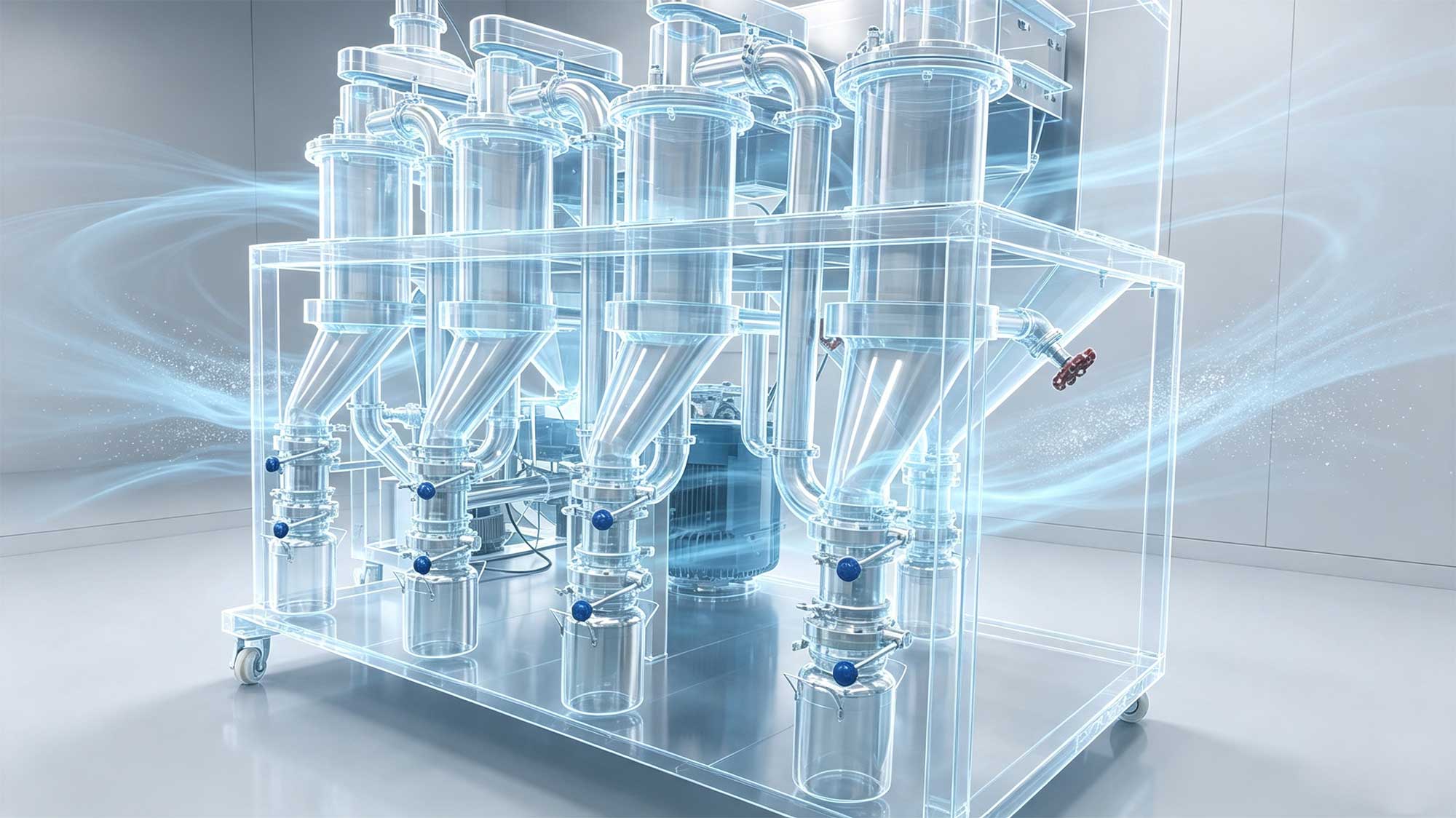
A multi-stage classifier is an air classification system that uses several high-precision turbo-classification wheels arranged in series. Each stage operates at different rotational speeds, airflow rates, and cut points, allowing the system to separate powder particles by size, density, and aerodynamic behavior.
A single-stage classifier typically makes only one main cut. It can separate coarse particles from fine particles, but it struggles to achieve very narrow particle size distributions, especially when strict control of oversize particles is required.
A multi-stage system solves this problem by making multiple precise cuts in sequence.
Common Multi-Stage Configurations
The number of stages should be selected based on product fineness, particle size distribution requirements, and production flexibility.
Two-Stage Classifier
A two-stage configuration is the most widely used general-purpose solution. It is suitable for applications where one main fine fraction and one coarse fraction are required.
Typical uses:
- Ultrafine calcium carbonate
- Coated kaolin clay
- Industrial mineral fillers
- Standard coating and ink powders
Three-Stage Classifier
A three-stage classifier separates material into coarse, medium, and fine fractions. It is ideal for plants that need to produce multiple product grades from the same raw material.
Typical uses:
- High-end coating fillers
- Electronic-grade silica
- Lithium battery materials
- Talc and mica powder processing
Four-Stage Classifier
A four-stage system provides the highest level of classification accuracy and is used when extremely narrow particle size distribution and strict oversize control are required.
Typical uses:
- MLCC ceramic powders
- Pharmaceutical API fine powders
- High-purity quartz powders
- Advanced functional fillers
Why Multi-Stage Classification Is Better Than Single-Stage
1. Narrower Particle Size Distribution
Multi-stage classification reduces the span between D10, D50, and D97. This means fewer oversized particles and fewer excessively fine particles in the final product.
For high-precision applications, this directly improves downstream performance, such as coating gloss, battery stability, ceramic strength, and ink dispersion.
2. Better Control of Oversize Particles
In many high-tech industries, even a small amount of oversize particles can cause quality problems.
For example:
- In lithium battery materials, large particles may cause electrode coating defects.
- In MLCC ceramics, oversize particles may affect dielectric performance.
- In pharmaceutical powders, inconsistent particle size may affect dissolution and dosage uniformity.
A multi-stage classifier removes oversize particles step by step, making it easier to achieve zero-tolerance quality standards.
3. Higher Product Yield
A single-stage classifier often returns a large amount of near-size material for regrinding, which increases energy consumption and reduces system efficiency.
A multi-stage system removes coarse particles early, protects the fine classification stage, and reduces the amount of material that needs to be reprocessed. This usually improves overall throughput and reduces specific energy consumption.
4. Flexible Production of Multiple Grades
One of the biggest advantages of multi-stage classification is that it can produce several different powder grades simultaneously.
For example, a three-stage system may produce:
- Coarse fraction for low-cost filler applications
- Medium fraction for standard industrial use
- Fine fraction for high-end coating or electronic applications
This improves raw material utilization and increases the economic value of the same mineral feedstock.
Key Selection Parameters for Multi-Stage Classifiers
1. Feed Particle Size
The particle size of the incoming material determines the required first-stage cut point.
If the feed is relatively coarse, the first stage should remove large particles before they enter the fine classification zone. If the feed is already fine, the system can focus more energy on narrow distribution control.
2. Finished Particle Size
The target cut points are the most important parameters. Typical classification targets include:
- D50: median particle size
- D97: top-cut particle size
- Dmax: maximum allowable particle size
- Particle size distribution span
For ultra-fine products, smaller classification wheels and higher rotational speeds are usually required.
3. Production Capacity
Capacity directly determines the diameter and number of classification wheels.
- Laboratory and small pilot lines: small diameter wheels, low feed rate
- Medium production lines: medium-sized turbo classifiers
- Large industrial plants: large-diameter multi-stage systems with high airflow capacity
It is important to match the classifier with the upstream mill, dust collection system, and blower capacity.
4. Material Density and Hardness
Denser particles require stronger centrifugal force to be separated. Harder materials also require special wear protection.
For example:
- Calcium carbonate and kaolin clay are relatively easy to classify.
- Quartz powder, silicon carbide, and metal powders require stronger wear resistance.
- High-purity electronic materials require ceramic-lined or non-metallic contact components.
5. Material Viscosity and Agglomeration
Some powders tend to agglomerate, especially when they are fine, moist, or oil-absorbent.
In such cases, the system may require:
- Pre-dispersion equipment
- Higher airflow velocity
- Mechanical deagglomeration
- Temperature control to reduce sticky behavior
6. Explosion Protection and Temperature Requirements
Materials such as metal powders, lithium battery materials, and organic powders may create explosion risks.
In these cases, selection should include:
- Nitrogen inerting system
- Explosion-proof electrical design
- Static elimination
- Pressure relief safety devices
Thermosensitive materials may also require cold air classification to avoid product degradation.
7. Contact Material Quality
Different industries require different levels of material purity and equipment hygiene.
- General industrial: carbon steel with wear-resistant lining
- Food and pharmaceutical: stainless steel, polished interior, easy-clean design
- Lithium battery and electronics: ceramic lining, minimal metal contact
- High-purity minerals: non-contaminating linings and carefully selected valve materials
Industry-Specific Selection Guide
Lithium Battery Cathode Materials
Lithium battery materials require strict control of oversize particles, magnetic contamination, and particle size distribution.
Recommended configuration:
- Two or three-stage classification
- Ceramic-lined classification wheels
- Low-contamination design
- Dmax control for high-consistency electrode coating
Electronic Grade Fillers
Electronic-grade silica, alumina, and ceramic powders require extremely fine particle size and very low impurity levels.
Recommended configuration:
- Three or more classification stages
- High-speed fine classification wheels
- Full ceramic or non-metallic contact design
- Strict control of D97 and Dmax
Pharmaceutical and Health Product Powders
Pharmaceutical powders require hygienic design, easy cleaning, and consistent particle size for dissolution and dosage control.
Recommended configuration:
- Two-stage classification
- 316L stainless steel contact parts
- Mirror-polished interior
- GMP-compatible design
Coatings, Inks, and Paints
In coatings and inks, particle size affects gloss, transparency, hiding power, and dispersion stability.
Recommended configuration:
- Two-stage classification for most filler applications
- Three-stage classification for high-value-added products
- Stable D97 and controlled fine particle content
Non-Metallic Mineral Processing
Recommended configuration:
- Three or four-stage classification
- Simultaneous production of multiple grades
- High wear resistance
- Large capacity design for industrial mining lines
Metal Powders and Magnetic Materials
Metal powders require both precise classification and safe handling.
Recommended configuration:
- Two-stage classification
- Inert gas protection
- Explosion-proof design
- Anti-oxidation process control
Common Selection Mistakes to Avoid
More Stages Are Not Always Better
More stages increase investment cost, pressure drop, and energy consumption. For many applications, a well-designed two-stage system is more economical than an unnecessarily complex four-stage system.
Do Not Only Look at D97
A good particle size distribution requires attention to D10, D50, D97, and Dmax together. Two products with the same D97 can perform very differently if their distribution spans are different.
Always Test with Actual Material
Powder behavior is difficult to predict only by theory. The same classifier may perform differently on calcium carbonate, kaolin, quartz, and metal powder.
Before final selection, it is recommended to run classification tests with the customer’s own raw material.
Do Not Compare Only Equipment Price
Multi-stage classification systems consume significant electrical energy over their lifetime. The total cost of ownership includes equipment price, installation cost, energy cost, maintenance cost, and after-sales service.
Recommended Selection Process
- Define product requirements, including feed size, finished particle size, capacity, and special material properties.
- Conduct laboratory classification tests with actual raw materials.
- Compare two or three technical configurations based on accuracy, capacity, and energy consumption.
- Visit existing reference projects in the same or similar industry.
- Confirm delivery time, installation support, spare parts supply, and after-sales service.
Conclusion
Multi-stage classifiers are essential equipment for high-precision ultra-fine powder production. They are especially valuable when narrow particle size distribution, strict oversize control, and multi-grade production flexibility are required.
When selecting a multi-stage classifier, the most important factors are particle size target, feed characteristics, production capacity, material hardness, and industry-specific purity requirements.
For most ultra-fine powder producers, the best approach is to balance classification accuracy, system energy efficiency, and long-term operational cost rather than simply choosing the largest or most complex machine.
If you provide your raw material type, feed particle size, finished product requirements, and target capacity, we can propose a more specific multi-stage classification solution for your production line.